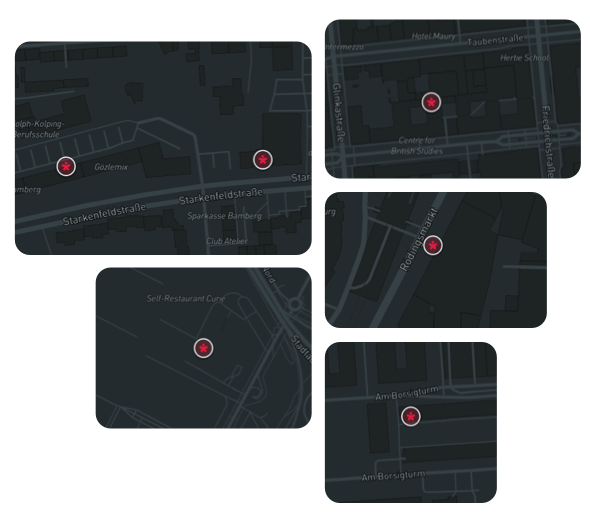
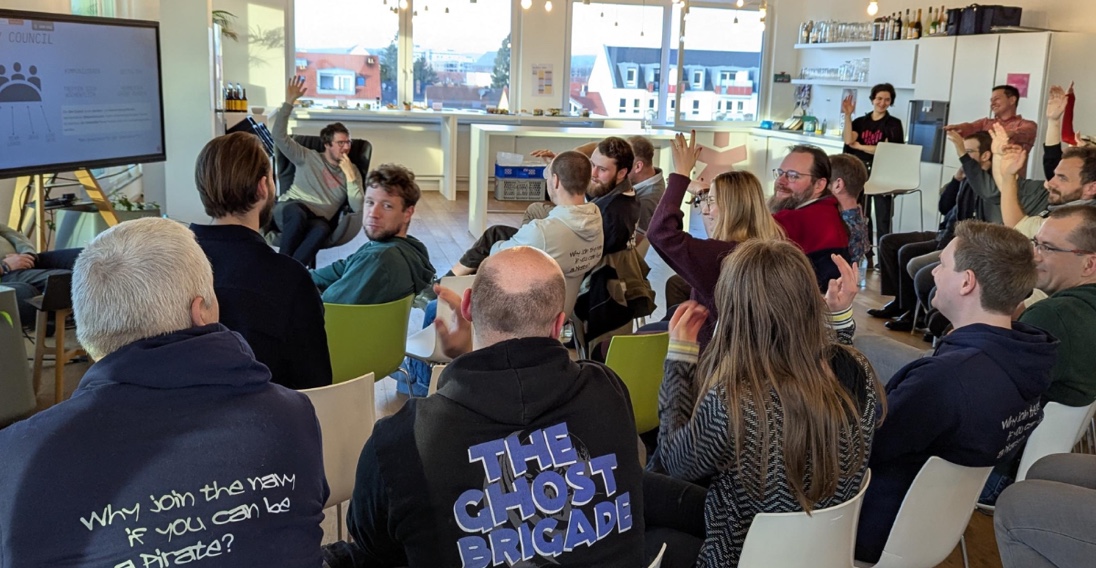
With participants from all our locations, it quickly became clear that DevDays is a format that not only connects
people, but also brings topics to the point in a structured manner.
Workshops instead of lectures: collecting problems, developing solutions
The focus was on workshops. This is an important difference: not “consuming program items”, but working together on real
issues.
The process was deliberately pragmatic:
Topics could be prepared in advance
They were collected, prioritised and distributed among rooms on site.
The aim was to develop concrete approaches, decisions or next steps within the workshop time frame.
This approach is also exciting for other teams: workshops work particularly well when change is imminent,
because uncertainties become visible, different perspectives come together and results can be recorded directly.
From the Scrum/Sprint rhythm to project mode
A major focus of DevDays 2026 was the shift from the sprint rhythm (Scrum) to a project mode. Many companies are
familiar with this: Scrum can be powerful – but not every environment benefits in the long term from a rigid
sprint cycle. As soon as dependencies increase, priorities change more frequently or teams need to work more closely
together across domains, a different model is often required.
What we hope to achieve with the project mode:
Simpler and closer collaboration between teams and roles
Less friction due to “sprint limits”, more focus on goal orientation
Overall more agile working in terms of adaptability, not just in terms of a framework
At the same time, it is clear that such changes raise questions – from responsibilities and planning to the definition
of “done”. This is exactly what the workshops were ideal for: ambiguities and uncertainties could be collected, sorted
and addressed specifically.
UX/UI: User Experience as Engineering-Topic
Another focus was UX/UI – not as a “side issue in design”, but as a key lever for product quality.
Why this is relevant (even outside your own organization):
A positive user experience reduces support costs, increases product acceptance and shortens training time.
UX does not begin with the UI: it starts with information architecture, workflows, performance and consistency.
The best interface is of little use if processes, statuses and error messages are not designed to be “engineering-compatible”.
The workshops focused on how UX/UI and development can work together more effectively: earlier mutual understanding,
clearer decision-making bases and more focus on the actual user experience.
Artificial intelligence in everyday development: practical examples, standards, quality
AI was also an important topic at DevDays 2026, but not as “let’s get started now,” but rather as
the next step on a path we have already embarked upon. This time, the focus was on a concrete example
from everyday work that showed how AI is already being used and what benefits it can bring to engineering.
This gave all teams a shared picture of what is already possible today and where it makes sense to
expand further.
This was accompanied by the question of how we can use AI responsibly and with quality assurance so that productivity
does not come at the expense of security, maintainability, or reliability.
Typical questions that many teams are concerned with:
Which tasks are well suited for AI support?
How do we ensure quality when AI provides suggestions?
How do we handle knowledge, data and responsibility?
The added value thus lay primarily in a common understanding: AI as a tool that can make us faster and better
when standards, boundaries, and expectations are clear.
Transferable insights for practical application: What companies can learn from DevDays 2026 about project mode, UX/UI, and AI
Even though DevDays 2026 took place internally, the principles can be easily transferred:
Workshops beat status updates
If you want change, you need formats that enable decisions to be made – not just exchanges.
Agility is not a framework, but a skill
Whether sprint mode or project mode: the decisive factor is how well teams can adapt to new requirements.
UX is a team sport
UX/UI improves measurably when development, product and design have common criteria and feedback loops.
AI needs guidelines
Teams benefit most when they define areas of application, clarify quality mechanisms and synchronise expectations.
Conclusion
DevDays 2026 was the starting point for a year in which we are not only building features, but also consciously working on the
fundamentals: collaboration, product quality, user experience, and the meaningful use of AI. The
cross-location participation and workshop format resulted in exactly what many organizations are looking for:
joint alignment and concrete solutions at the same time.